Skip to main contentHow does the OP Stack stay up to date with the latest innovation?
The OP Stack is Optimism’s open-source software for deploying next-generation onchain products. The software is licensed under the MIT license, meaning it can be freely used and forked by all parties. The OP Stack has a vibrant core developer community who contribute to the stack, ensuring it reflects the features and values protocol users care about.
The Superchain is an ecosystem of chains running on Optimism’s OP Stack, featuring some of the world’s largest enterprises. Superchain networks benefit from shared security, upgrades and services provided by Optimism. Each chain maintains peak performance with access to innovative new features developed anywhere on the stack, continually strengthening the entire Superchain ecosystem. Chains may also configure components of the OP Stack to fit their regulatory and business needs while still benefiting from shared infrastructure and innovation. Learn more about the best way to build on the OP Stack for your business here.
How are new features added to the OP Stack?
OP Labs and external contributors determine the feature roadmap. Based on discussions, protocol upgrades are drafted, which go through the protocol upgrade process.
What is the protocol upgrade process?
The protocol upgrade process is designed to make sure the OP Stack does not change against the interests of the businesses building on the platform. This is a key benefit of crypto systems compared to their centralized alternatives. Platform risk is a common risk of Web 2 platforms and is a key consideration for the largest partners building on the OP Stack.
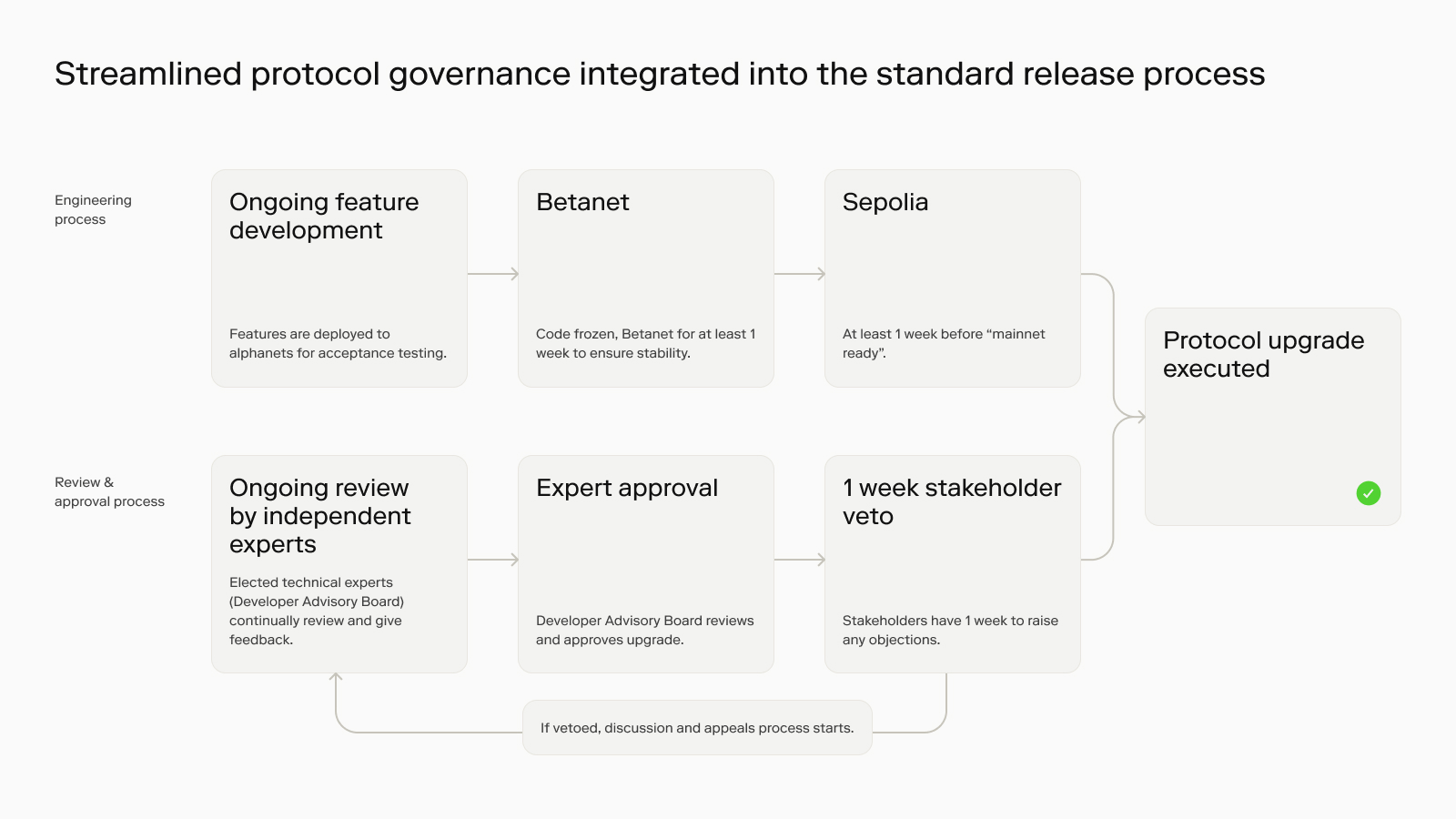
Protocol upgrades are drafted by OP Labs or other core contributors to the OP Stack. Before they are implemented, they are reviewed by an independent group of developers (the Developer Advisory Board) to ensure the upgrade is well justified.
After a proposal has been reviewed by the Developer Advisory Board, it enters a 7 day veto period. This allows all impacted stakeholders, namely tokenholders, chains, apps, and end-users to override the DAB’s decision if they believe an upgrade disadvantages their interests. This is how platform risk is reduced for key stakeholders of the OP Stack.
If a proposal is veto’d, it enters an appeals and discussion phase and can be resubmitted.
For full details about the protocol upgrade process, please see the Operating Manual.
Overall - contributors, tokenholders, chains, apps, and end-users all have a voice. Checks and balances exist so that no single entity (including OP Labs or the Foundation) can unilaterally dictate the future of the OP Stack.
Platform risk is reduced by distributing veto power across stakeholder groups while maintaining an efficient core developer process. This ensures upgrades happen quickly but can be vetoed if they harm key stakeholders.
How can my chain specifically influence the feature roadmap?
Superchain members who contribute revenue back to the Collective are consulted by OP Labs and core developers about the feature roadmap to ensure their voices are heard. All development happens in the open and chains are encouraged to participate and share their perspectives within various research and development repositories.
How does Optimism help my chain achieve decentralization?
Permissionless Fault Proof OP Chains that have their upgrade keys managed by the Optimism Security Council are classified as Stage 1 in L2Beat’s framework. This distributed group delivers the benefit of security scrutinized upgrades that are managed by Optimism.